




THE SUPPORTERS CIRCLE
All the benefits of The Extraordinary Form, plus:
Custom giving level
This is more than a membership—it’s a commitment to advancing the mission and helping shape its future.

Liechtenstein’s Hereditary Prince Alois has pledged to prevent the legalisation of abortion in the principality, saying he would use his veto should a proposal permitting abortion during the first trimester win public approval.
Prince Alois, who serves as Liechtenstein’s regent, made his position clear in a June 17 interview with the Liechtenstein newspaper Vaterland, as the campaign to liberalise the country’s abortion laws gathers support.
There is something particularly striking about looking at Liechtenstein from Britain. While its hereditary prince is prepared to say publicly that he would use his constitutional authority to prevent the legalisation of abortion, the British Crown has long since retreated from any comparable intervention in the moral legislation of the nation.
Britain was among the earlier Western European countries to liberalise its abortion laws with the Abortion Act 1967. What was presented at the time as a limited reform has developed into a regime under which abortion is permitted in Great Britain in most circumstances up to 24 weeks, with later abortions lawful on certain specified grounds. In practice this has become abortion on demand. Hundreds of thousands of abortions now take place each year in England and Wales, and many people are pushing for Abortion up to birth.
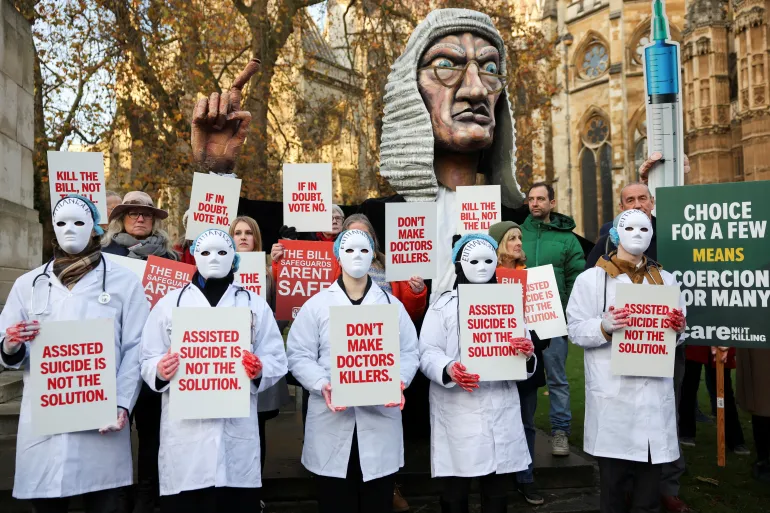
And now Parliament has been considering another profound change: the legalisation of assisted dying for terminally ill adults. Once again, legislators are being asked to cross a boundary that previous generations regarded as fundamental, this time concerning the deliberate assistance of a person in ending his or her own life.
How extraordinary it would be if, at such a moment, the British monarch were to rediscover something of the constitutional courage displayed by Prince Alois.
Royal Assent has not been refused in Britain since Queen Anne withheld it from the Scottish Militia Bill in 1708. In modern constitutional practice, the monarch is expected to act on ministerial advice, and a refusal of Royal Assent would undoubtedly provoke an enormous constitutional crisis. Yet the very existence of the power reminds us that the Crown was not conceived merely as a decorative flourish attached to parliamentary government.
For Catholics in particular, the contrast is difficult to ignore. Here is a tiny European principality whose future sovereign is prepared to put his authority on the line over the protection of unborn life, while Britain, whose monarch is crowned in a profoundly Christian ceremony and bears the title Defender of the Faith, contemplates extending the principle of legally sanctioned death from the beginning of life to its end.
One may understand all the constitutional arguments against royal intervention and still permit oneself the thought: what a remarkable thing it would be if the King said no.
There are moments when a civilisation has to ask whether everything that can command a parliamentary majority should therefore become law. If so then law is nothing but a utilitarian expression. This was not always so, and Prince Alois gives us hope that the long forgotten principle of human law being subject to the natural law, may yet stir in the hearts of men.
The Catechism of the Catholic Church teaches that natural law provides the “necessary basis for the civil law”.
“No one can command or establish what is contrary to the dignity of persons and the natural law.” RCC 2235
In paragraphs 72 and 73 of Evangelium Vitae Pope St John Paul II explicitly connects civil law, natural law, abortion and euthanasia. After invoking the traditional teaching that civil law must conform to moral law, he says laws legitimising the direct killing of innocent human beings through abortion or euthanasia are contrary to the fundamental right to life.
“A civil law authorizing abortion or euthanasia ceases by that very fact to be a true, morally binding civil law.”
“Abortion and euthanasia are thus crimes which no human law can claim to legitimize.”
Liechtenstein’s prince appears willing to recognise this truth. It is difficult not to wish that our own Crown still possessed the freedom and the courage to do the same.