




THE SUPPORTERS CIRCLE
All the benefits of The Extraordinary Form, plus:
Custom giving level
This is more than a membership—it’s a commitment to advancing the mission and helping shape its future.
Written by C.Huxley for Catholic Unscripted
The English are notoriously preoccupied with the weather. Our unpredictable weather patterns often serve as a source of polite, uncontentious conversation. Usually, it is mild, offering us the opportunity to recount self-deprecating tales of getting drenched by an unexpected downpour or getting horribly sunburnt because we forgot that such things can happen in England. Plus ça change!
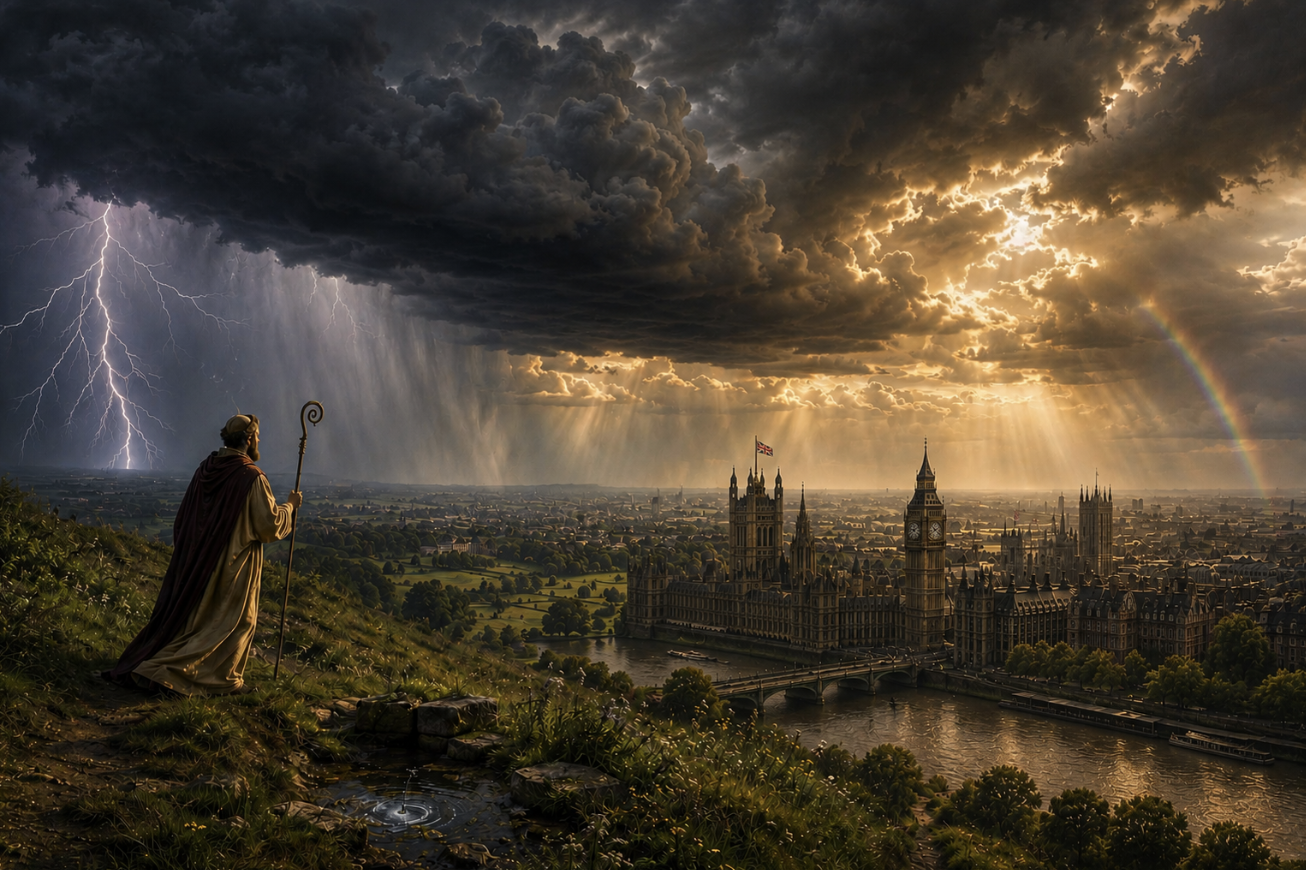
Occasionally, weather-talk has more potency. Last night, a vast and spectacular thunderstorm swept across large parts of the island of Great Britain, bringing house fires started by lightning strikes and flash flooding. It was weather we might describe as Biblical. This raises an interesting question. Why is it, in the era of modern meteorology, that people instinctively look for meaning in the weather, especially when it coincides with momentous events in our temporal lives?
In Medieval times, people often over-interpreted weather and celestial events. Halley’s comet is memorialised in the Bayeux tapestry’s telling of the defeat of the Anglo-Saxons at the Battle of Hastings. Chroniclers interpreted the eclipse on the night Richard III’s wife died in 1485 as an ill omen of his impending doom.
Shakespeare understood this instinct well. In Macbeth and King Lear, stormy weather mirrors the human disorder and moral chaos that comes from the violation of natural law. Thus, while Christians should avoid superstition, perhaps we have lost something valuable in ceasing to regard the natural world as capable of inviting reflection and wonder.
The English countryside is littered with place names that hint at our pagan ancestors’ veneration of Woden, the chief God in their pantheon. His name derives from ‘furious’ or ‘raging’ and was often associated with the natural world. Howling gales and storms were explained as Woden leading the Wild Hunt across the sky. They may have mistaken the source, but they had not yet forgotten to listen.
When the water tables rise and cause chalk streams to burst their banks we still call the water in the flooded meadows Woe Waters. This reflects local folklore, which tells us that in the past people attributed dry streams to Woden’s displeasure. Such traditions preserved the memory of a time when people believed the health of the land reflected the relationship between humanity and the divine.
History records that southern England was experiencing such a drought in 597AD, when St Augustine arrived on his mission from Rome. He visited King Ethelbert at his Palace in Lyminge, where legend has it that he knelt in prayer and a spring miraculously gushed forth, to the immense joy of everyone in the valley. The well that marks the spot and the village church are still dedicated to his daughter Queen Ethelburga. Christianity did not abolish the sense that the divine speaks through nature; it redirected it.
The relationship between weather, humanity and God has long been part of the Christian tradition. The Old Testament is full of stories from Noah’s flood to Elijah’s drought that tell us of God’s people being punished and the land cleansed through extreme weather events. In the Gospels, Jesus calms a storm on the Sea of Galilee. The weather is not used to punish, but to reveal Jesus’s divine authority over nature and to instil faith. It reminds us that when we face metaphorical storms, we can find stillness and peace in Christ. Scripture does not contain a meteorological horoscope, but it does reveal that God has on occasion chosen to speak through wind, rain, drought and darkness.
Even the most materialistic of people can suddenly become medieval when the sky behaves dramatically at a moment of national importance. Yesterday our Prime Minister resigned, and the Mayor of Manchester and heir-apparent Andy Burnham was sworn into Parliament. If, as expected, Andy Burnham becomes our next Prime Minster, perhaps his premiership will one day be seen through the lens of last night’s storm.
Whether coincidence or providence, the instinctive tendency for people to reach for meaning has not vanished entirely. We saw this in 1935, when many interpreted the unusual weather as foretelling the death of King George V. In 2022 the country experienced three nights of electric storms immediately prior to the death of Queen Elizabeth II. As Buckingham Palace announced her passing, the skies cleared and multiple rainbows appeared, reminding us of her deep faith and the biblical significance of rainbows as visible markers of God’s enduring grace.
Ever since Keats complained that philosophy had unwoven a rainbow, we have been battling the tension between our reductive tendency to explain all phenomena in purely material terms and our human need for meaning. Our ancestors may sometimes have been too eager to interpret every gust of wind as a direct message. By contrast, we may have become too eager to dismiss the natural world as having nothing meaningful to offer us. We can look at a thunderstorm as a meteorologist does, but we can also, as Lewis suggested, ‘look along it’ as human beings, asking ourselves what it prompts us to think about the human condition and our relationship with God.
Christians should not become augurs, scanning the clouds for secret messages. Yet neither do we believe that God’s creation is a closed system that He set in motion and then abandoned. The God who once spoke through whirlwind, drought and darkness remains the Lord of All. The next time thunder rolls across the Shires, perhaps the question is not whether it predicts anything, but whether we have remembered to listen.