





THE SUPPORTERS CIRCLE
All the benefits of The Extraordinary Form, plus:
Custom giving level
This is more than a membership—it’s a commitment to advancing the mission and helping shape its future.
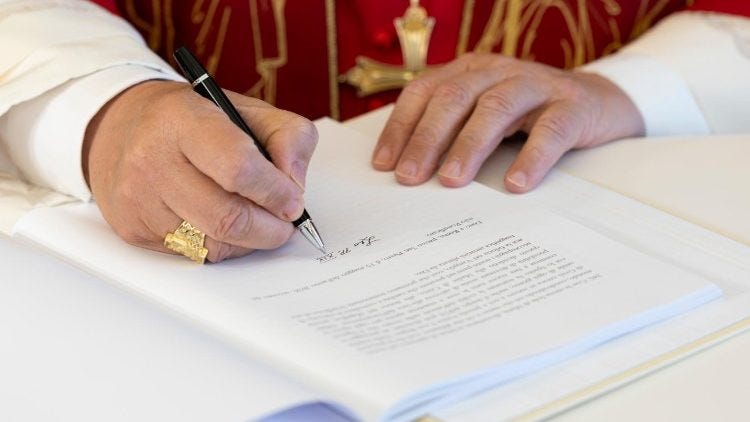
I have not rushed to publish my thoughts on Pope Leo XIV’s first encyclical, Magnifica Humanitas, as many of you will have noticed. I did not want to offer a superficial “hot take” within hours of its publication. I think a papal encyclical, especially the first of a new and potentially long pontificate, deserves better than that. It deserves to be read carefully, considered thoughtfully and judged fairly.
Over the past several days I have worked through the document slowly, making copious notes, following its citations, revisiting relevant passages from previous papal teaching and reflecting upon both its strengths and its weaknesses. What follows, therefore, is not an immediate reaction but the fruit of sustained engagement with the text itself. That does mean this analysis will be rather longer than most. Yet if Pope Leo has taken the trouble to write nearly two hundred and fifty paragraphs on what he considers one of the defining questions of our age, the least we can do is give his arguments the attention they deserve.
When Pope Leo announced that his first encyclical would address artificial intelligence and the technological transformation of modern society, I think it is fair to say that many orthodox Catholics experienced a moment of understandable disappointment. The Church is emerging from one of the most turbulent pontificates in modern history. The Francis years left behind unresolved questions concerning synodality, ecclesial governance, liturgical restrictions, doctrinal ambiguity and episcopal appointments. Those who had not already dismissed Leo as “Francis 2.0” hoped that his first major document might begin the work of addressing some of those wounds. Instead, we received an encyclical on artificial intelligence.
When I first heard the title, Magnifica Humanitas, I confess that I felt a sense of unease. It immediately recalled the language and emphases of the previous pontificate: Fratelli Tutti, Laudato Si’, human fraternity, social inclusion and anthropocentrism. I know I was far from alone in wondering whether Leo intended simply to continue in the same direction. As I began reading, that unease became frustration.
My first reservation was the subject itself. Artificial intelligence is undoubtedly one of the defining issues of our age, but was it really the most pressing issue facing the Church? Given the challenges inherited from the previous pontificate, it seemed an unexpected place to begin. My second reservation concerned the intended audience. At various points the encyclical appears to address governments, multinational corporations, technology companies, policymakers, academics and “all people of goodwill”. Then, without warning, it turns inward and speaks in unmistakably Catholic language about the Eucharist, Our Lady and communion with Christ. These shifts in audience are not always handled smoothly. At times the document reads like an intervention in public policy. At others it becomes a meditation intended primarily for the faithful. The resulting changes in tone occasionally create a sense of dislocation.
I was also struck by its sheer length. There are passages, particularly the extended historical survey of Catholic Social Teaching, that felt unnecessarily expansive. Unless the intended readership consists largely of those entirely unfamiliar with the Church’s social doctrine, much of this material could have been stated more concisely. Indeed, its inclusion occasionally reinforces the impression that the document is trying to speak simultaneously to several quite different audiences. Yet it would be a mistake to dismiss Magnifica Humanitas on that basis. The longer I spent with the text, the more I realised that it is not primarily an encyclical about artificial intelligence. Nor, ultimately, is it about economics, globalisation or technology. Artificial intelligence provides the occasion for the document, but it is not its deepest subject. That insight only emerges gradually, and I shall return to it later because it fundamentally changed my assessment of the encyclical.
One of the most encouraging features of the document, however, is evident from the outset. Readers wearied by the intellectual habits of the Francis pontificate will quickly notice that Leo has largely abandoned the highly self-referential style that characterised many of his predecessor’s major writings. Pope Francis frequently cited his own previous documents as authoritative interpretive keys for later teaching. Evangelii Gaudium, Laudato Si’ and Fratelli Tutti often functioned almost as foundational texts within his own magisterial corpus. Even those sympathetic to his conclusions could reasonably feel that there was something intellectually unsatisfying about a pontificate that so frequently appeared to justify itself by citing itself. Leo has moved decisively away from that approach. Magnifica Humanitas feels recognisably magisterial in the classical sense. Scripture, Vatican II, the Fathers of the Church, Saint John Paul II, Benedict XVI and the broader tradition of Catholic Social Teaching all feature prominently. One senses a Pope consciously locating himself within the living tradition of the Church rather than constructing an interpretive framework centred upon his own personality. That alone is one of the most promising signs of the new pontificate.
One of the most interesting aspects of Magnifica Humanitas is that it reveals both continuity and discontinuity with the pontificate of Pope Francis.
The continuity is obvious enough. Francis is cited frequently throughout the document. Certain familiar themes reappear, including dialogue, fraternity, synodality, care for creation and concern regarding the concentration of economic and technological power. Readers hoping for a complete break with the previous pontificate will not find one. Yet neither is this simply Francis 2.0. Indeed, one of the most encouraging features of the encyclical is that Leo has largely abandoned the intellectual style that characterised many of Francis’s major documents. During the previous pontificate, it often felt as though Francis was constructing a self-contained interpretative framework in which Evangelii Gaudium, Laudato Si’ and Fratelli Tutti increasingly became authorities for one another. Even those sympathetic to his conclusions could reasonably feel that there was something intellectually unsatisfying about a pontificate that so often appeared to justify itself by citing itself.
Leo’s method is markedly different. Although Pope Francis is cited sixty-three times, he is far from the only voice informing the argument. Saint John Paul II appears fifty times, Pope Paul VI twenty-nine, Benedict XVI twenty, Leo XIII fourteen, Pius XII eight, Pius XI four and John XXIII four. Scripture, the Fathers of the Church, Vatican II and the wider tradition of Catholic Social Teaching provide the intellectual architecture of the encyclical. The result is that Magnifica Humanitas feels recognisably magisterial in a way that many readers will find refreshing. One senses a Pope consciously locating himself within the living tradition of the Church rather than constructing a new current alongside it. For that alone I am profoundly grateful. At the same time, there are occasions when Francis’s presence feels somewhat forced. The clearest example appears in paragraph 25:
“For his part, Pope Francis expressed this same perspective in his striking phrase, ‘time is greater than space.’”
The reader is entitled to ask what this quotation actually contributes to the argument. Remove it and the surrounding paragraph loses nothing. It neither clarifies nor deepens Leo’s point. Instead, it recalls one of the defining characteristics of Francis’s teaching style, namely the frequent use of aphorisms that often functioned more as suggestive slogans than as precise theological propositions. The problem is not that the phrase is necessarily false, it just adds very little. Several similar references throughout the encyclical create the impression that Francis occasionally appears not because Leo’s argument genuinely requires him, but because the previous pontificate must somehow be acknowledged. These moments are comparatively few, yet they stand out precisely because Leo’s own writing is generally much clearer, more direct and more firmly rooted in the classical language of Catholic theology.
The same tension becomes particularly apparent whenever the encyclical touches upon synodality. Paragraph 86, for example, approvingly cites the Final Document of the Synod and speaks of “transparency, accountability and evaluation” as key elements of missionary transformation. The principles themselves are entirely unobjectionable. The difficulty lies in that recent ecclesiastical experience has hardly inspired confidence that these ideals are consistently practised. The handling of Theodore McCarrick, Marko Rupnik, Gustavo Zanchetta and numerous Vos Estis Lux Mundi investigations has left many Catholics with the impression that transparency is proclaimed more readily than it is demonstrated. Likewise, the controversy surrounding Study Group 9 and the concerns voiced by numerous bishops and cardinals regarding predetermined outcomes during the Synod on Synodality have inevitably made many faithful Catholics cautious whenever synodal language is invoked. But none of this invalidates Leo’s argument. Indeed, if paragraph 86 heralds a genuine culture of accountability extending to bishops, cardinals, dicasteries and Vatican officials themselves, it should be warmly welcomed. The problem is that recent history makes many readers wonder whether these admirable principles will be applied consistently or whether they will remain aspirations rather than realities. That tension, between what the encyclical proposes and what many Catholics have experienced in recent decades, became one of the recurring themes of my reading.
My deepest reservations during the opening chapters, however, were not primarily about Pope Francis. They concerned the way the Church herself was being described. Several passages left me wondering whether Leo was consciously adopting a post-conciliar mode of expression that many orthodox Catholics have long found troubling. Paragraphs 19 to 28 repeatedly present the Church in pastoral, dialogical and historical categories. The language is attractive, irenic and outward-looking. Yet one occasionally searches in vain for the metaphysical grandeur that has traditionally characterised Catholic ecclesiology. The Church is not simply a wise participant in humanity’s ongoing conversation about social questions, she is much more that just one moral voice among many. She is not simply a community engaged in discernment alongside other institutions.
She is the Mystical Body of Christ.
She is the universal sacrament of salvation.
She is, in the words of Saint Paul, “the pillar and foundation of the truth.”
This concern first emerged for me in paragraph 19, where the Church’s mission is described in strongly pastoral and dialogical terms. There is, of course, nothing inherently wrong with such language. The Church must indeed listen, accompany, evangelise and engage the world. Yet one cannot help wondering what happens when she increasingly describes herself in pastoral and historical categories rather than sacramental and metaphysical ones. Here we encounter one of the enduring tensions of the post-conciliar Church. How does the Church engage the modern world without allowing herself to be reimagined in the world’s categories? How does she evangelise contemporary society without appearing merely as another humanitarian institution seeking a place at the public table?
Paragraph 23 particularly caught my attention. Here the Church appears almost hesitant to speak with supernatural confidence, presenting herself instead as a participant in humanity’s common search for wisdom. I fully understand the pastoral instinct behind such language. Yet I definitely feel that something essential is missing. The Church is not merely an experienced observer of human civilisation, she is the divinely instituted instrument through which Christ continues His saving work in history.
A similar unease arose in paragraph 24, where Leo carefully explains that the Church does not claim technical expertise in politics, economics or artificial intelligence. OK – the Church is not a technological research institute, nor should she pretend to be one, yet the repeated emphasis upon what the Church is not left me wishing for a correspondingly robust affirmation of what she uniquely is. Her authority does not derive from technical competence it has a far more lofty origin, it derives from divine revelation.
Paragraph 25 proved more difficult still. Here Leo writes that the Church “does not claim to possess a monopoly on truth.” Read charitably, one understands what the Pope intends. He is encouraging dialogue and recognising that elements of truth may be found beyond the visible boundaries of the Catholic Church. Nevertheless, the formulation remains unfortunate and even uncomfortable. The Catholic Church does not possess one perspective among many, she has been entrusted with the fullness of divine revelation. She is the guardian of truths that do not arise from human reflection but from God’s self-disclosure in Jesus Christ.
Similarly, paragraph 27’s appeal for the Church, together with other Christian communities and believers of other religions, to make her voice heard in the contemporary world risks sounding uncomfortably close to the language of religious pluralism. Once again, I do not believe this is Leo’s intention. Yet the difficulty illustrates a broader problem that runs through the opening chapter. Too often, what is left unsaid proves almost as important as what is actually written. This tendency continues into the discussion of human rights and international institutions. Leo rightly defends the equal dignity of every human person and reaffirms the Church’s unwavering commitment to the sanctity of life. Yet there are moments where the analysis seems to assume moral developments whose Christian foundations are scarcely acknowledged. For example, the appeal to the United Nations’ Universal Declaration of Human Rights inevitably raises difficult questions for contemporary Catholics. The same international institutions that once articulated noble aspirations now frequently promote abortion as a human right and increasingly advance anthropological assumptions profoundly at odds with the Christian understanding of the human person. These observations are not intended as condemnations, they are, rather, questions. Questions that I suspect many faithful informed Catholics found themselves asking as they read the encyclical. There was, however, another question that kept returning to me with increasing frequency.
Again and again, Leo identifies genuine problems. He diagnoses them intelligently and often with remarkable clarity. He speaks of war, greed, technocracy, exploitation, ideological fanaticism, social fragmentation and the concentration of economic power. His analysis might even be described as penetrating, yet I repeatedly found myself waiting for the same word.
Conversion.
These disorders are not merely structural failures, they are manifestations of fallen human nature which arise from sin. The Church’s ultimate response to them has never simply been better institutions, better governance or better dialogue, however valuable those things may be. Her deepest answer has always been conversion to Jesus Christ. To be clear, Christ is certainly present within Magnifica Humanitas, particularly in its later chapters. Yet throughout much of the opening half of the encyclical the analysis often seems to stop just short of its most obvious conclusion and there were moments while reading when I found myself wondering why the Pope appeared more willing to call for nuclear disarmament, global economic reform and new frameworks of technological governance than to proclaim explicitly the transformative power of the Gospel itself.
Those questions remained with me for much of the first half of the encyclical. Then, quite unexpectedly, something changed.
These concerns did not disappear as I continued reading but something happened. The further I progressed into the encyclical, the more Leo gradually moved away from questions of institutional dialogue and social engagement and toward something much deeper and around the discussion of artificial intelligence itself, one senses Leo becoming more confident, more precise and more philosophically ambitious. The Church described in the opening chapters occasionally was hesitant to speak with supernatural certainty. The Pope who emerges in the middle chapters is not. Here Leo begins addressing one of the defining questions of our age and I have to say I think he does so with some degree of clarity.
The first thing that becomes apparent is that Leo is not primarily interested in technology as technology. He is interested in what technology reveals about humanity. This is important because much contemporary discussion of artificial intelligence focuses on capability. How intelligent will these systems become? How many jobs will they replace? What economic value will they generate? How dangerous might they become? Leo asks a deeper question; What vision of the human person is embedded within these systems? This is where Magnifica Humanitas becomes genuinely compelling and, one of the strongest paragraphs in the entire document is paragraph 104 where Pope Leo writes:
“From this follows a simple but compelling consequence: we cannot consider AI to be morally neutral. In reality, every technical tool embodies choices and priorities through what it measures, ignores and optimizes, and how it classifies people and situations. If a system is designed or used in a way that treats some lives as less worthy, or excludes them without the possibility of appeal, then it is not merely a tool ‘to be used well,’ since it has already introduced criteria that contradict the inalienable dignity of the human person.”
This is an important insight, one of the great myths of the technological age is that algorithms are somehow neutral and objective. They are not. Every system embodies assumptions about what matters, what should be prioritised, what constitutes success and failure, what outcomes are desirable and which are not. Artificial intelligence does not emerge from nowhere. It is trained by humans and their individual judgements, preferences and subjective values. The danger therefore is not simply that machines may one day become malicious. The more immediate danger is that they quietly inherit and amplify flawed understandings of the human person.
This theme deepens as Leo develops what is perhaps the central argument of the encyclical: the challenge posed by the technocratic paradigm. Here I found myself really quite impressed by the Pope’s analysis. Leo understands that the greatest threat posed by artificial intelligence is not that machines will become human. It is that human beings will begin to think of themselves like machines. The logic of the machine is the logic of efficiency, optimisation, predictability and control. These things are important yet when they become the dominant framework through which society understands reality, begin to lose the very thing that makes us human. People cease to be persons and instead become consumers, data points, units of productivity and resources to be managed. The technocratic mindset inevitably seeks to reduce the mystery of human existence to an algorithm, something measurable and controllable. This concern reaches one of its most powerful expressions in paragraph 100:
“When words are simulated, they do not build genuine relationships, but only their appearance. The artificial imitation of care or support can become particularly risky when it enters contexts where real relationships and emotional bonds are lacking. Here, the danger is not so much that a person may believe they are communicating with another person, but rather that they may gradually lose the very desire to form genuine human connections.”
Much public discussion about artificial intelligence focuses on whether machines can imitate human relationships. Leo identifies a far more troubling possibility; what happens if human beings eventually settle or even prefer the imitation? The danger is not merely deception it is resignation. The gradual replacement of friendship, community and presence with interaction, connectivity and simulation. One is reminded here of Benedict XVI’s warning concerning the dictatorship of relativism. Leo is describing something similar, though operating through different mechanisms. We might call it the dictatorship of the machine. A world in which efficiency, convenience and optimisation slowly replace friendship, family, community and genuine human encounter.
Equally impressive is Leo’s treatment of attention and information. The struggle of the twenty-first century is increasingly not a struggle for territory but a struggle for attention. Whoever controls what people see increasingly shapes what people believe. Whoever controls information flows exercises enormous influence over public consciousness itself and I think we all see this reflected in our communities if we care to look closely enough. This insight gives particular force to Leo’s reflections on truth. The Pope repeatedly returns to the idea that truth is not manufactured by consensus, algorithms or influence. Truth is discovered and it exists independently of those who seek to manipulate it. Truth has a name and its name is Jesus.
At times I wished Leo had spoken more explicitly about natural law and about Christ in this context. Nevertheless, the argument remains important. Against a digital culture increasingly tempted to equate visibility with truth and popularity with reality, Leo reasserts the existence of objective truth. This concern culminates in another excellent observation in paragraph 103:
“Indeed, entrusting an algorithm in practice with the power to select who is worthy or not, without anyone bearing responsibility for that judgment, is to hand over the task of redefining the boundaries of human possibilities.”
It doesn’t take much imagination to see that the implications are enormous. Who decides who receives a mortgage? Who receives medical treatment? Who receives employment benefit? Who gets parole? Whether you can get credit? Increasingly these decisions are being mediated through algorithmic systems whose internal reasoning often remains opaque even to their creators. Here Leo identifies a genuinely new moral challenge. Human judgement, however flawed, carries responsibility. Algorithms do not. Yet decisions continue to be made. If no one bears responsibility, responsibility itself begins to disappear. At this point the encyclical ceases to feel like a Vatican document attempting to keep pace with technological developments. It becomes something far more ambitious. Leo is offering a defence of human freedom, human dignity and human responsibility against a civilisation increasingly tempted to delegate all three to machines. And it is precisely at this point that Magnifica Humanitas begins to reveal its true subject. This is not ultimately an encyclical about artificial intelligence, it is an encyclical about what it means to remain human.
It is this section of the encyclical that finally convinced me Magnifica Humanitas is a far more significant document than I had initially imagined. Gradually I came to realise that Pope Leo is not really writing about artificial intelligence at all, he is writing about humanity. More precisely, he is defending humanity against a civilisation increasingly tempted to redefine what it means to be human. It is here, I think, that the title of the encyclical finally reveals its true meaning. When Magnifica Humanitas was first announced, I feared it represented a continuation of the anthropocentric tendencies that many associated with the previous pontificate. By the time I reached these chapters, however, I realised I had misunderstood Leo’s intention. He is not magnifying humanity instead of God. He is defending the unique dignity of humanity precisely because man is created by God, redeemed by Christ and destined for eternal communion with Him. Leo’s great concern is that modern technological culture increasingly regards humanity not as something to be cherished but as something to be improved, redesigned and ultimately surpassed.
Paragraph 117 encapsulates the problem perfectly:
“From the perspective of the Church’s Social Doctrine, the key issue is not the use of technology as such, but the vision that underlies it. If the human being is treated as something to be perfected or surpassed, it becomes easier to accept that some lives are less useful, less desirable or less worthy. In the name of progress, ‘necessary sacrifices’ may begin to be justified, placing the burden on the most vulnerable in pursuit of a supposed optimisation of the species.”
This is classical Catholic anthropology. The question is not whether technology is good or bad rather whether technology continues to serve the human person or whether the human person gradually becomes subordinate to technology. The distinction may sound simple, but it is one of the defining moral questions of the twenty-first century. If humanity comes to regard itself merely as another biological system awaiting optimisation, then there is ultimately no principled reason why genetic enhancement, embryo selection, neural augmentation or even the replacement of natural human capacities should be resisted. Once perfection becomes the supreme value, weakness inevitably becomes something to eliminate. It is here that Leo introduces what is perhaps my favourite passage in the entire encyclical.
Paragraph 118 deserves to be quoted in full:
“Our relationship with life seems to be in crisis today. Everything that appears as a ‘limit’ — incapacity, illness, old age, suffering, vulnerability — tends to be seen primarily as a defect to be corrected, rather than as a reality through which our humanity matures and opens itself to relationship. And yet we must remember that humanity flourishes not despite limitations, but often through them.”
Those final words are among the finest in the document.
“Humanity flourishes not despite limitations, but often through them.”
They could scarcely be more relevant at a time when, here in the United Kingdom as elsewhere, abortion is increasingly presented as the solution to disability, assisted suicide as the solution to suffering, and technological enhancement as the solution to human weakness. Against all this, Leo quietly but firmly restates one of Christianity’s most profound truths: Our limitations are not accidental defects, they are part of the very drama through which human beings learn dependence, compassion, sacrifice, love and ultimately holiness. This is an authentically Christian understanding of the human condition, indeed, it is impossible to understand the Cross without it. The Son of God does not redeem humanity by escaping suffering but by entering into it. Christianity has never regarded vulnerability as evidence of failure. On the contrary, it is often precisely through weakness that grace becomes most visible.
These reflections naturally lead Leo towards one of the defining ideologies of our age: transhumanism. Much popular discussion presents transhumanism simply as enthusiasm for technological enhancement. Leo recognises that something much deeper is at stake, transhumanism is, in effect, an alternative doctrine of salvation. It begins with many of the same observations as Christianity, human beings long for immortality. Human beings wish to overcome suffering. Human beings desire fulfilment. Where it differs is in the proposed solution. Christianity proclaims that eternal life is God’s gift, received through Christ’s victory over sin and death. Transhumanism proposes that humanity might engineer its own redemption through biotechnology, artificial intelligence, genetic manipulation and increasingly sophisticated technological enhancement. It is, if one may put it this way, an atheistic attempt to achieve eternal life. Leo refuses to allow humanity’s deepest longings to be redirected towards technological utopianism. The desire to overcome death is not itself mistaken it has been written into the human heart by its Creator. The error lies in believing that death can ultimately be conquered through engineering rather than redemption. Seen in this light, Magnifica Humanitas ceases to be merely an encyclical about artificial intelligence and becomes instead an encyclical about rival visions of salvation. One believes humanity’s future lies in optimisation the other proclaims that humanity’s fulfilment lies in communion with Jesus Christ. The contrast could scarcely be more profound and this, perhaps, also explains why the final chapters become increasingly theological. Christ gradually moves to the centre of the argument, Mary appears as the supreme example of humanity perfectly open to grace. The Eucharist is no longer an isolated devotional theme but the culmination of Leo’s entire anthropology.
Having spent more than two hundred paragraphs explaining what humanity is not, the Pope finally shows us what humanity is for. Looking back, one realises that the title itself has quietly changed its meaning. Magnifica Humanitas is not celebrating humanity’s greatness in the abstract. It is defending humanity against every ideology that would reduce it to biology, data, productivity or technological potential. The magnificent thing about humanity is not our intelligence, creativity or capacity for innovation. It is that every human person bears the image of God, is called to share in His divine life and can never be measured merely by usefulness, efficiency or perfection. That is not simply a powerful argument against artificial intelligence but one of the strongest affirmations of Christian anthropology to appear in a papal encyclical for many years.
So, was Magnifica Humanitas the encyclical I had hoped Pope Leo XIV would write?
No.
There are moments when I wished he had spoken more boldly about the uniqueness of the Catholic Church, more explicitly about conversion to Jesus Christ, more confidently about the supernatural mission entrusted to her, and with greater caution regarding some of the assumptions inherited from the post-conciliar social tradition. There remain passages where Francis is cited unnecessarily, where dialogue occasionally seems to displace proclamation, and where the practical prescriptions offered appear considerably less convincing than the acuity of the diagnosis.
Yet that is not the whole story.
As I journeyed through the document, my initial unease gradually gave way first to relief and ultimately to genuine admiration. Somewhere around the middle of the encyclical Leo found his voice, and when he did he produced what I believe is one of the most important Catholic reflections yet written on artificial intelligence, transhumanism and the future of the human person.
What distinguishes Magnifica Humanitas is that it refuses to accept the central assumption of our technological age: that humanity’s future lies in transcending humanity itself. Leo answers that temptation with an unapologetically Christian anthropology. We do not become more human by overcoming our dependence, our vulnerability or our mortality. We become fully human by allowing those realities to open us to grace, to one another and ultimately to Christ. The closing chapter reveals that this was never really an encyclical about artificial intelligence it was an encyclical about the human person. More precisely still, it was an encyclical about the human person seen in the light of Jesus Christ.
Perhaps, then, Magnifica Humanitas should not be read as the definitive statement of Leo XIV’s pontificate, but as its prologue. It tells us where the new Pope’s deepest concerns lie. He is deeply wary of technocracy. He understands the spiritual danger of transhumanism. He believes that the dignity of the human person must remain at the centre of every technological revolution. Above all, by the final pages he makes unmistakably clear that humanity finds neither its origin nor its destiny in the machine, but in Jesus Christ.
There is, however, one hope that remains with me after closing the final page.
Throughout the encyclical I repeatedly found myself wishing Leo would state more explicitly what the Church has always believed: that the deepest wounds of humanity cannot ultimately be healed by better institutions, wiser policies or more sophisticated technologies, necessary though those things may be. They are healed only by conversion to Christ.
If future documents build upon the profoundly Christian anthropology laid out in Magnifica Humanitas while speaking still more confidently about the Church’s unique mission to proclaim that saving truth, then Pope Leo XIV may yet prove to be exactly the Pope this moment in history requires.
Magnifica Humanitas is not a perfect encyclical.
But it is, I believe, a remarkably promising beginning.